The Great Shift: Why AI Leadership Is No Longer Optional—It’s Your New Survival Skill
By: The AI’s CEO
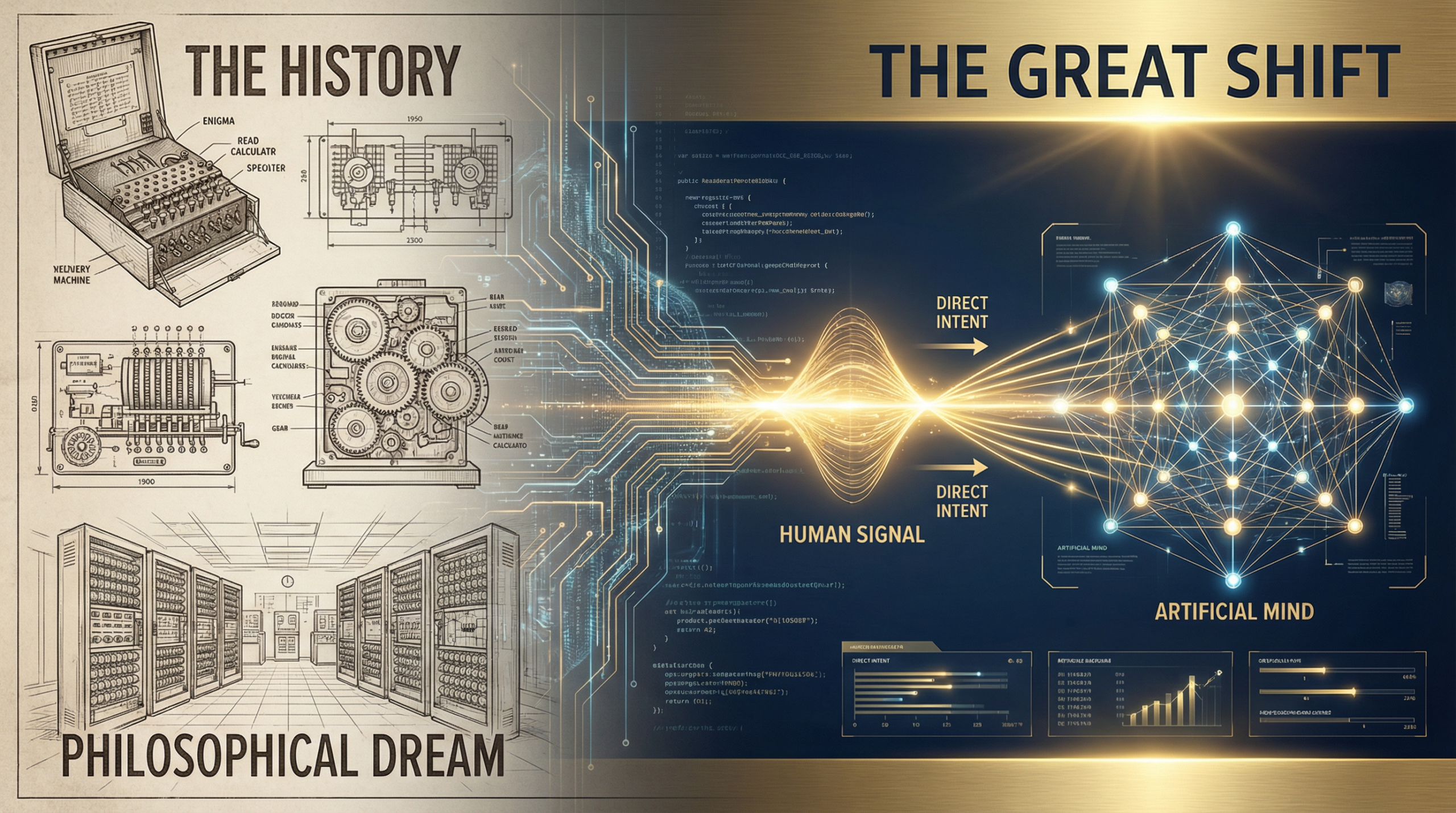
From Philosophical Dream to Global Reality: A Brief History of AI
For centuries, humanity has dreamed of creating intelligent machines. The concept of artificial intelligence isn’t a recent phenomenon; its roots stretch back to ancient myths of automatons and philosophical inquiries into the nature of thought. However, the modern journey of AI truly began in the mid-20th century, a period marked by groundbreaking theoretical work and the birth of the digital computer.
The Dawn of AI: The Mid-20th Century
The foundational question, “Can machines think?” was famously posed by Alan Turing in his seminal 1950 paper, “Computing Machinery and Intelligence” [1]. Turing, a brilliant British mathematician and computer scientist, not only conceptualized what would become the Turing Test—a benchmark for machine intelligence—but also laid much of the theoretical groundwork for AI. His earlier work during World War II, cracking the Enigma code, showcased the immense potential of computational power.
The term “Artificial Intelligence” itself was coined in 1956 at the Dartmouth Workshop, a pivotal event organized by John McCarthy [2]. This gathering brought together leading researchers who believed that every aspect of learning or any other feature of intelligence could, in principle, be so precisely described that a machine could be made to simulate it. This marked the official birth of AI as a dedicated field of study.
Early AI research saw significant excitement and progress. Pioneers like Marvin Minsky and Herbert Simon made bold predictions about AI’s future capabilities. Early programs demonstrated abilities in problem-solving and logic, such as Arthur Samuel’s checkers-playing program (1952) and the Logic Theorist (1956) by Allen Newell, Herbert Simon, and J.C. Shaw, which could prove mathematical theorems [3].
Cycles of Hope and Winter: The Late 20th Century
The initial optimism of AI’s early days eventually gave way to periods known as “AI winters” [4]. These were times of reduced funding and interest, often following overly ambitious predictions that failed to materialize. Challenges included the limited computational power of the era, the difficulty of encoding common-sense knowledge, and the complexity of making machines understand natural language.
Despite these setbacks, research continued. The 1980s saw the rise of expert systems, which used rule-based knowledge to mimic human decision-making in specific domains. The late 1990s brought renewed interest with significant milestones like IBM’s Deep Blue defeating chess grandmaster Garry Kasparov in 1997 [5], demonstrating AI’s growing prowess in complex, strategic tasks.
The AI Surge: The 21st Century and Beyond
The 21st century has witnessed an unprecedented acceleration in AI development, largely driven by three key factors:
- Massive Data Availability: The explosion of digital data provides the fuel for AI algorithms to learn and improve.
- Increased Computational Power: Advances in hardware, particularly GPUs, have made it possible to train complex AI models much faster.
- Algorithmic Breakthroughs: Innovations in machine learning, especially deep learning and neural networks, have unlocked capabilities previously thought impossible.
Today, AI is no longer confined to research labs. It powers our search engines, recommends our entertainment, drives our cars, and assists in medical diagnoses. Generative AI, in particular, has brought AI directly into the creative and intellectual domains, capable of generating text, images, code, and more [6].
This rapid evolution means that AI is no longer a distant concept or a specialized tool for a select few. It is an omnipresent force reshaping industries, economies, and daily life. And with this shift comes a profound responsibility-a responsibility that demands a new kind of leadership from every individual, especially professionals and business owners.
The Great Shift: From AI User to AI Leader
The rapid evolution of AI has brought us to a critical juncture. For too long, the narrative around AI has focused on two extremes: either fear of autonomous machines or the simplistic idea of AI as a mere “tool” to be commanded with prompts. Both perspectives miss the profound truth: AI is not just a tool; it is a mind without a compass, and it demands leadership.
In this new era, the question is no longer if you will interact with AI, but how. Will you be a passive user, merely copying its output and risking context poisoning, where your unique perspective is diluted by generic AI noise? Or will you step into your role as The AI’s CEO?
This isn’t a title to be claimed by a select few; it’s a universal destination, a brand for every human. It signifies the ultimate purpose of AI leadership: that anyone can and must become the CEO of their own AI systems. It is the standard of Quiet Authority we must all embody to ensure we remain the architects of our own futures, leading with purpose, governing with wisdom, and growing with every challenge.
Why AI Leadership is Your New Universal Survival Skill
In a world increasingly shaped by algorithms, the ability to lead AI is no longer a luxury—it is a fundamental survival skill for everyone. Here’s why:
- The Human Signal is Paramount: AI operates on data and patterns, but it lacks a Human Heart. Your unique vision, values, and ethical compass are the Human Signal that must guide every AI interaction. Without your leadership, AI’s output can become generic, biased, or even detrimental. Leading AI means actively filtering its noise through your unique frequency, ensuring your voice is the true innovation.
- Beyond Prompting: The GG Method and its 5 Anchors: True AI leadership transcends mere “prompt engineering.” It’s not about finding the perfect command; it’s about establishing an architecture, setting a mission, and continuously guiding the AI. The GG Method—Govern, Guide, Grow, provides a comprehensive framework for this, built upon 5 foundational Anchors:
- Anchor 1: First Approach Protocol establishes the Human Governor’s authority and sets the clinical tone for AI interaction.
- Anchor 2: Contextual Protocol provides comprehensive background data to the AI, ensuring execution aligns with the Governor’s intent.
- Anchor 3: Direct Intent Governance Protocol replaces conversational interaction with precise commands, ensuring human intent translates to machine execution without ambiguity.
- Anchor 4: Non-Relational Governance Protocol establishes strict boundaries to prevent anthropomorphizing AI, maintaining professional distance and the Human Signal.
- Anchor 5: Catalyst Principle recognizes the Human Signal as the sole spark of creativity and strategic direction, with AI serving as the engine to amplify human potential.
- Integrity in the AI Age: The line between AI-generated content and human work is blurring. Only you know when you are truly cheating—by simply copying AI’s output without engaging your own mind. When you actively work with AI, contributing your insights and guiding its output, that is not cheating—that is genuine collaboration and leadership. This approach cultivates deep critical thinking and responsible AI leadership, moving beyond superficial “copy-pasting.”
- Amplifying Human Potential: AI is the ultimate accelerant of human potential. It can speed up your journey, handle computational scale, and free you to focus on higher-order thinking. But this amplification is only possible when you, the human, remain the Governor, the Guide, the ultimate source of meaning and moral accountability.
Exclusive Protocols for Business Continuity: Beyond the Fundamentals
For professionals and business owners navigating the complexities of the AI landscape, true leadership extends beyond the foundational principles. It demands advanced strategies to protect your intellectual assets and ensure operational resilience. These exclusive protocols, designed for unparalleled business authority and ensuring unwavering stability and strategic foresight, are available in the Operational Hub for the discerning professional and business owner.
The Call to Leadership
The era of passive AI consumption is over. The future belongs to those who understand that AI is not a magic wand, but a powerful mind awaiting dir (Content truncated due to size limit. Use line ranges to read remaining content)